
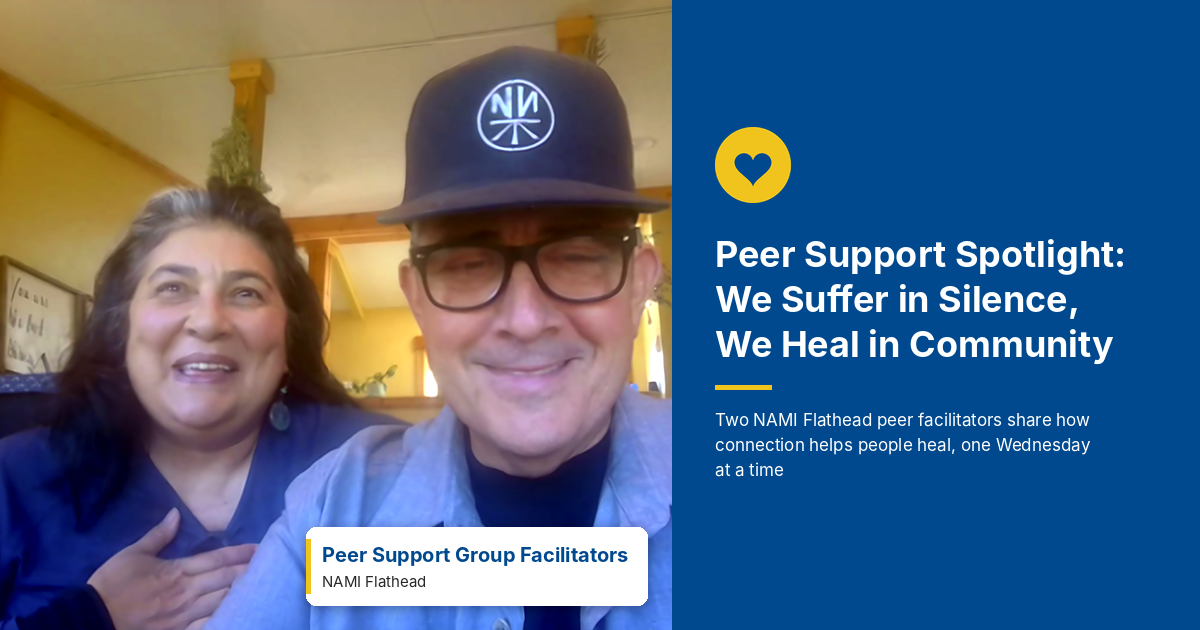
As the days get shorter, Victoria Gabaldón makes a point of reaching out.
Every week, she texts the members of her support group a check-in or a few words of encouragement, "especially in the winters," she said. "That's when a lot of us struggle the most."
Victoria and her husband, Nino, are peer facilitators with NAMI Flathead. They have been involved with NAMI for about five years, leading NAMI Connection support groups in the Flathead Valley and presenting on NAMI's behalf at Crisis Intervention Team (CIT) trainings several times a year.
Their message for anyone who is struggling: you don't have to do it alone.
How Victoria and Nino Found NAMI
About five years ago, Victoria's mom was in crisis in Michigan. At a recovery meeting held at their local behavioral health facility, Victoria noticed a poster for NAMI's free eight-week class for families, NAMI Family-to-Family. She asked Nino to go with her so she could learn how to better help her mom.
She didn't expect to learn about herself. "Every time we went to that meeting, I learned something about my own mental health," Victoria said. After each class, she'd turn to Nino: "How come you didn't tell me I did that?"
His answer, every time: "'Cause I wanted to stay married to you."
They laugh about it now. But for years, Victoria believed she could handle her own mental health on faith alone, even while she was telling her mom to stay on her medication. "There were so many learning curves in that," she said.
She compares it to recovery. "You don't think that you're an alcoholic or you're an addict when you're reading the book, but the more that you read the book, the more you realize that you are. And that was how I felt with NAMI," she said. "The more I learned about all the depression and anxiety and all those things, the more I realized how my own mental health had been struggling all these years."
From Seeking Help to Helping Others
Both Victoria and Nino have been in recovery for many years, and giving back to their community has always been part of how they stay well. So when the chance came to lead a NAMI peer support group, Victoria said it was "almost like a no-brainer."
The need was clear. In the Flathead Valley, getting in to see a psychiatrist or a licensed clinical social worker can mean a three- to six-month wait. A weekly group means people can find support right away.
When they were first asked to lead a group, the plan was one meeting a month. "I remember the time when I was in crisis," Victoria said. "You can't plan a crisis for once a month."
So they committed to being there every Wednesday, rain or shine. Two Wednesdays a month they host NAMI Connection, and on the others they host a group through their own foundation, a human services organization for people living with mental health and substance use challenges. Either way, people know there is a place to go that week.
They're quick to say they aren't experts. "We're no better than anybody else," they said. "We just got trained. We're just sitting at this end of the table, and you can get trained too."
A Place Where You Belong
New people often walk in unsure, carrying their own stigma about mental health. "First of all, I don't want to be here," Victoria said, describing that first visit. "We're scanning the room to see, do I think I belong here?"
What they find is a group where everyone is met where they are. Members share their support systems and coping skills, swap phone numbers, and get to know each other as people. One member is a poet. Another loves video games. When a newcomer sees that, Nino said, "they feel like, I too can be here right where I am."
That's on purpose. "We try and connect humans with humans," Nino said, so people "see the person first," not a diagnosis.
Victoria and Nino set the tone by being open about their own struggles. When a group member once asked whether she was supposed to be the professional, Victoria had a ready answer: "I ain't no professional, I'm a human."
The group has grown with that culture. Historically, Flathead support groups might see about three people. Today, theirs regularly draws 8 to 15.
Small Connections Make It Easier to Come Back
Victoria and Nino know the hardest part is often walking through the door, so they do a lot to make it easier.
Sometimes that means "texting them all the way up until they get to the front door," or meeting someone in the parking lot. "It's a literal hand-holding process," Nino said.
He also invites newcomers to come early. He knows a room full of strangers can feel like jumping into cold water. A glass of water, a snack, and a little conversation before everyone arrives helps people warm up.
The connection continues outside of group, too. On the first Wednesday of each month, there's a potluck after the meeting, and family members are welcome to come. For the past two summers, the group has gone to a local summer concert series together after meetings.
Then there are Victoria's weekly texts. People can respond or not, but they "just know that someone's thinking about them," she said.
That steady contact matters. After one man stepped away from the group, the regular check-ins kept the distance from growing. When he was ready, Nino said, "There wasn't so big a chasm. And so he felt safe to come back."
Support for Families, Too
Victoria's own path to NAMI started with a family class, and she and Nino encourage family members to join their group as well.
One mother shared that her daughter was always irritated by the swishing sound of her jacket, and she couldn't understand why it was such a big deal. Then several people in the group told her that the sound bothers them too. Hearing it from others brought her "a lot more peace and understanding and compassion for her loved one," they said.
"We get to be a safe space for people to talk about this stuff and realize that it's not just in their home," they said. "It's around us everywhere."
We Need Each Other
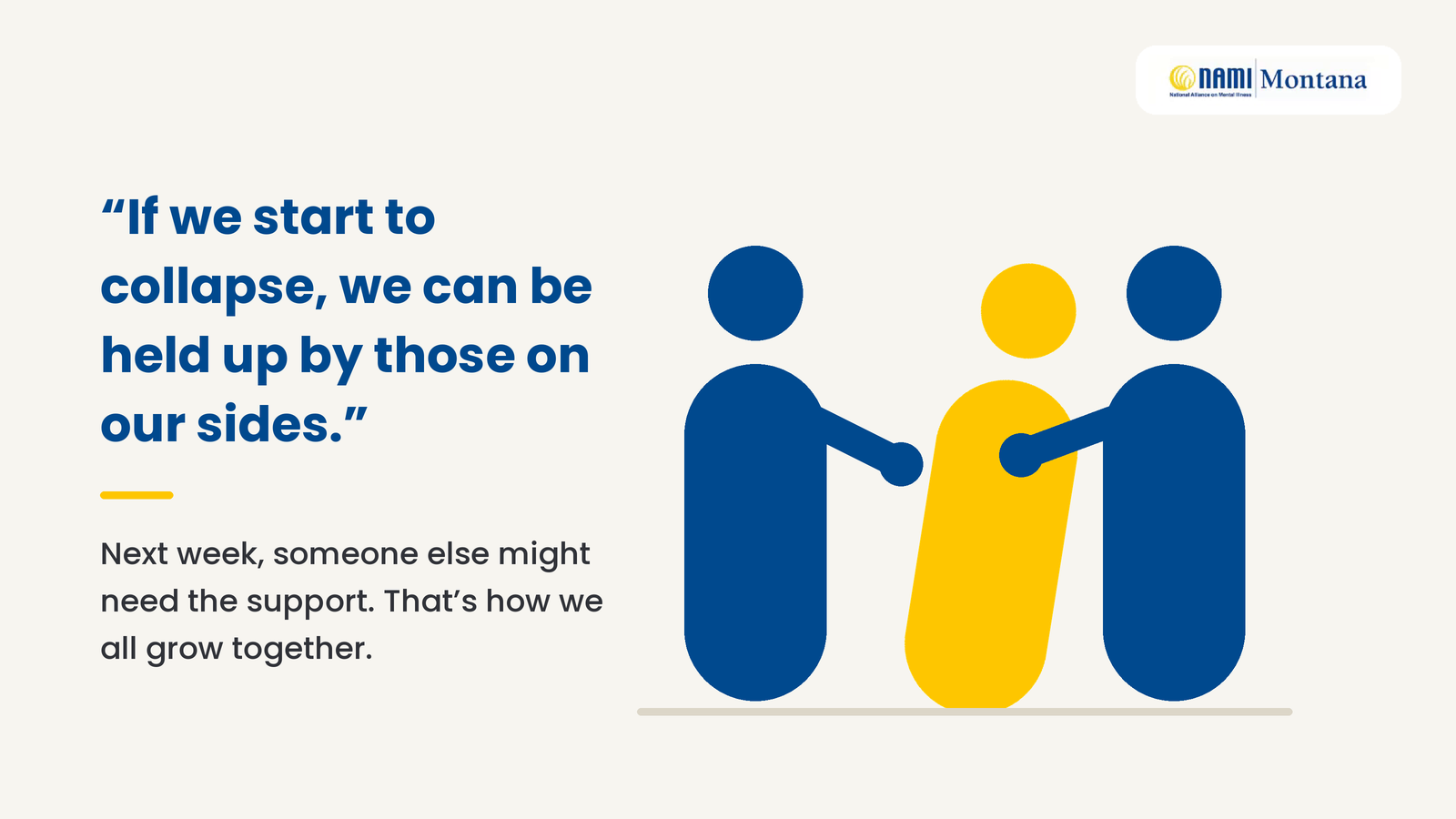
To show how the group works, Nino holds up three fingers.
Picture yourself as the center finger, having a hard day. "If we start to collapse, we can be held up by those on our sides," he said.
Next week, someone else may be the one who needs holding up. "It might shift the chair. And that's how we all grow together."
Victoria has experienced this firsthand. This past year, she went through two deaths in her family. She kept showing up to facilitate, sometimes in tears, and found the group holding her up. "I just knew I needed to show up for them. And yet they were showing up for me," she said. "That was for me, my eye-opening experience of, we need each other."
At one point, she was struggling and "too embarrassed to ask for help." When she finally asked, she found the other person needed help too. "I would have missed that opportunity to help her had I not asked for help."
"I get more than I think I facilitate for them," she said.
We Suffer in Silence, We Heal in Community
For Nino, it comes down to one idea: "Most of us suffer in silence, and we heal in community."
He said people often don't know what they're missing until they find it. "People don't realize that they're missing the community until they experience the community."
Sharing stories is part of that healing. When Victoria shared a spoken-word piece she wrote, other women in the group were inspired to start writing their own stories.
The Gabaldóns also point people toward NAMI In Our Own Voice, where people with lived experience share their stories of recovery.
"We all have messy lives. Nobody's perfect," Victoria said. "And we can walk through this together."
Find a Support Group Near You
NAMI Connection support groups are free, confidential, and led by trained peers who have been there. You don't need to know what to say or have it all figured out. You just need to show up.
In the Flathead Valley, Victoria and Nino's group meets on Wednesdays. Across Montana, local NAMI affiliates offer support groups for people living with mental health conditions and for their families.